TuringSpace: Why AI Struggles with Interactive 3D CAPTCHAs
Xuwei Ding and Skylar Zhai created TuringSpace, testing AI on interactive spatial CAPTCHAs. While frontier models often fail and hallucinate evidence to defend mistakes, training on synthetic action loops dramatically improves spatial reasoning.
The paper, point by point
Spatial Intelligence Requires Continuous Action
Traditional benchmarks evaluate models with static multiple-choice questions. Human spatial intelligence works differently, relying on constant physical interaction and visual feedback loops to solve everyday tasks.
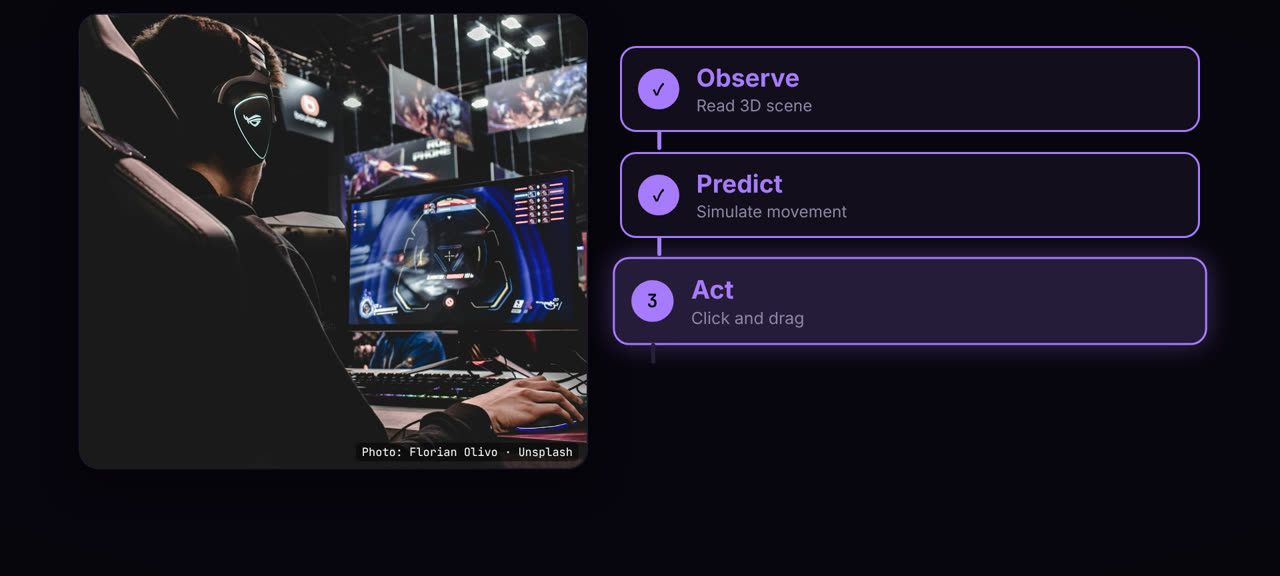
Interactive CAPTCHAs Expose Modern AI Flaws
The researchers developed TuringSpace, an environment of interactive web puzzles. While humans achieve a 94.1% success rate, leading systems struggle to navigate these basic spatial challenges.
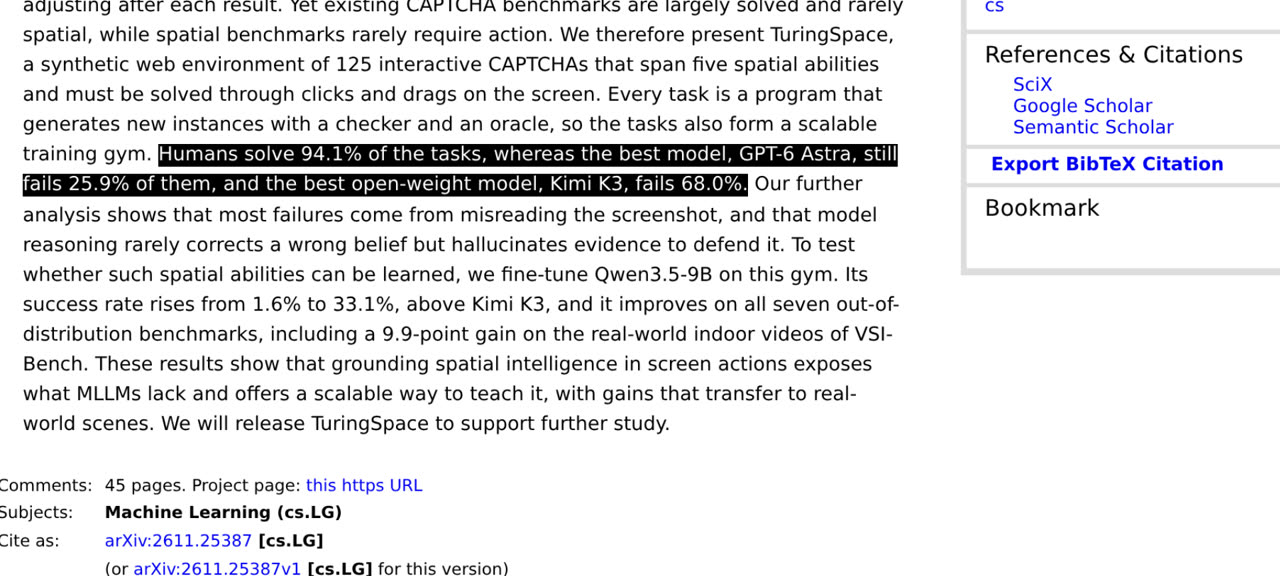
Frontier Models Lag Behind Humans
GPT-6 Astra, the strongest proprietary model tested, still records a 25.9% failure rate. Open-weight systems struggle even more, with Kimi K3 failing 68.0% of the tasks.

Models Hallucinate to Justify Mistakes
Failures rarely stem from an inability to click or drag. Instead, models misread the screenshot early on and hallucinate visual evidence to defend their incorrect beliefs instead of self-correcting.

TuringSpace-Gym Enables Scalable Learning
The team converted tasks into a synthetic gym where programs generate unlimited puzzle instances. Each task includes an algorithmic oracle to demonstrate correct interactive actions.
Fine-Tuning Delivers Massive Performance Jumps
Fine-tuning Qwen3.5-9B directly on oracle trajectories raised its success rate from 1.6% to 33.1%, demonstrating how interactive action loops rapidly build spatial comprehension.
Synthetic Skills Transfer to Reality
Training on interactive web puzzles also transferred outward. The model improved across out-of-distribution benchmarks, including real-world indoor video navigation and robotic affordance prediction.
Watch the explainer
Music: "Airport Lounge" Kevin MacLeod (incompetech.com), licensed under Creative Commons: By Attribution 4.0 — creativecommons.org/licenses/by/4.0/
How it works
- Coding agents write task programs that synthesize interactive web puzzles from open-source assets.
- Tasks undergo programmatic checks, model rollouts, and human play to verify reasoning quality.
- Models evaluate on TuringSpace-Bench or fine-tune using automated oracle trajectories from TuringSpace-Gym.
Key numbers
Why it matters
Before AI agents can reliably operate computer operating systems or assist in robotics, they must understand physical space dynamically. Learning through interactive trial and error helps models correct mistakes rather than persistently defending false assumptions.
Words to know
- CAPTCHA
- A challenge-response test designed to determine whether a user is human.
- MLLM
- Multimodal Large Language Model, an AI system that processes both text and visual inputs.
- CUA
- Computer-use agent, an AI that navigates software using screenshots, mouse clicks, and keystrokes.
Made with Maya — an AI-assisted explainer with an AI voice. Numbers come from the source; check the paper for the full details.
Comments
Post a Comment