SonoWorld4D: Turning Videos into 4D Audio-Visual Worlds

SonoWorld4D transforms a single flat video into an explorable 3D world with realistic, synchronized spatial audio that changes dynamically as you move around.
The paper, point by point
The Silent Problem in 4D Generation
Prior 4D visual scene generation methods completely ignore sound, even though audio is naturally coupled with moving objects. Existing audio approaches usually focus on static scenes or need highly constrained camera settings.

Splitting Background and Foreground
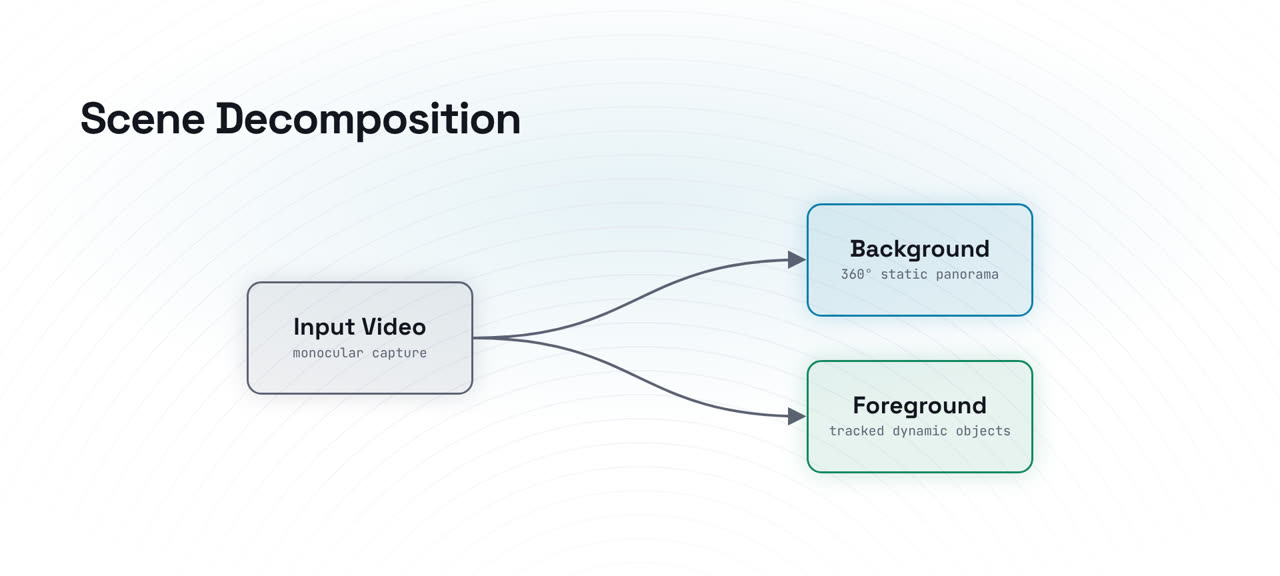
The first core idea splits the scene into a 360-degree static background panorama and explicit dynamic foreground objects with tracked world-space trajectories.
Synchronizing Space and Sound
The second key idea is dual-space diffusion synchronization. It concurrently generates and synchronizes camera-space audio and per-object canonical audio through forward acoustic rendering and inverse mapping.

Four-Stage Processing Pipeline
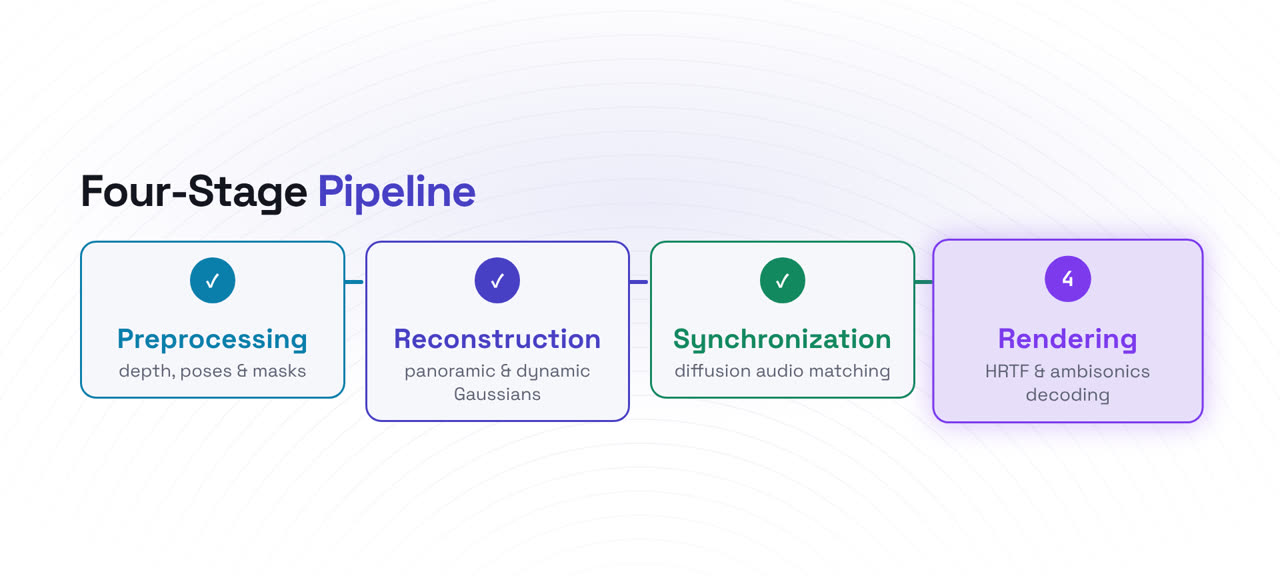
Processing runs in four stages. First, video preprocessing extracts depth, poses, and prompts. Second, scene reconstruction builds background and foreground Gaussians. Third, acoustic synchronization generates spatial sound. Fourth, free-viewpoint rendering outputs the final 4D world.
Superior Directional Accuracy
Evaluating direction-of-arrival absolute azimuth error on the SonoScene4D dataset, SonoWorld4D achieves 36.6 degrees, outperforming baseline Sonic4D at 54.3 degrees.
Better Spatial Energy Matching
For spatial energy correlation, higher values mean better matching. SonoWorld4D reaches 0.647, compared to Sonic4D at 0.446.
Watch the explainer
Music: "Carefree" Kevin MacLeod (incompetech.com), licensed under Creative Commons: By Attribution 4.0 — creativecommons.org/licenses/by/4.0/
How it works
- Extract depth maps, camera poses, foreground masks, and vision-language model audio prompts from the input video.
- Generate panoramic background Gaussians and motion-type-specific dynamic foreground Gaussians, then align them into a common world coordinate frame.
- Synthesize static background sounds and use bidirectional camera-object diffusion synchronization to generate consistent dynamic spatial audio.
- Render novel-view visuals and listener-dependent spatial audio along arbitrary target trajectories using HRTF decoding and ambisonics.
Key numbers
Why it matters
This research enables immersive VR environments and interactive virtual exploration generated directly from ordinary monocular videos. Creators and developers can add realistic spatial sound propagation to video editing and entertainment applications.
Words to know
- Diffusion Synchronization
- A technique that forces multiple AI generation processes to stay consistent with one another.
- First-Order Ambisonic (FOA)
- A full-sphere surround sound format that captures audio directionality.
- HRTF
- Head-Related Transfer Function, filters that help human ears perceive sound placement in 3D space.
Made with Maya — an AI-assisted explainer with an AI voice. Numbers come from the source; check the paper for the full details.
Comments
Post a Comment