NEO-VLA: Encoder-Free Vision-Language-Action Policies for Robots
Most AI robots compress camera images before deciding how to move, which loses fine spatial details. A new framework called NEO-VLA feeds raw pixels directly into the language backbone, achieving higher accuracy and robustness.
The paper, point by point
The Problem with Visual Compression
Most AI robots compress every camera image before deciding how to move. Standard vision encoders throw away thin edges, precise depth, and tiny surface boundaries, forcing the robot arm to navigate through a blurry abstraction.
Eliminating Visual Encoders
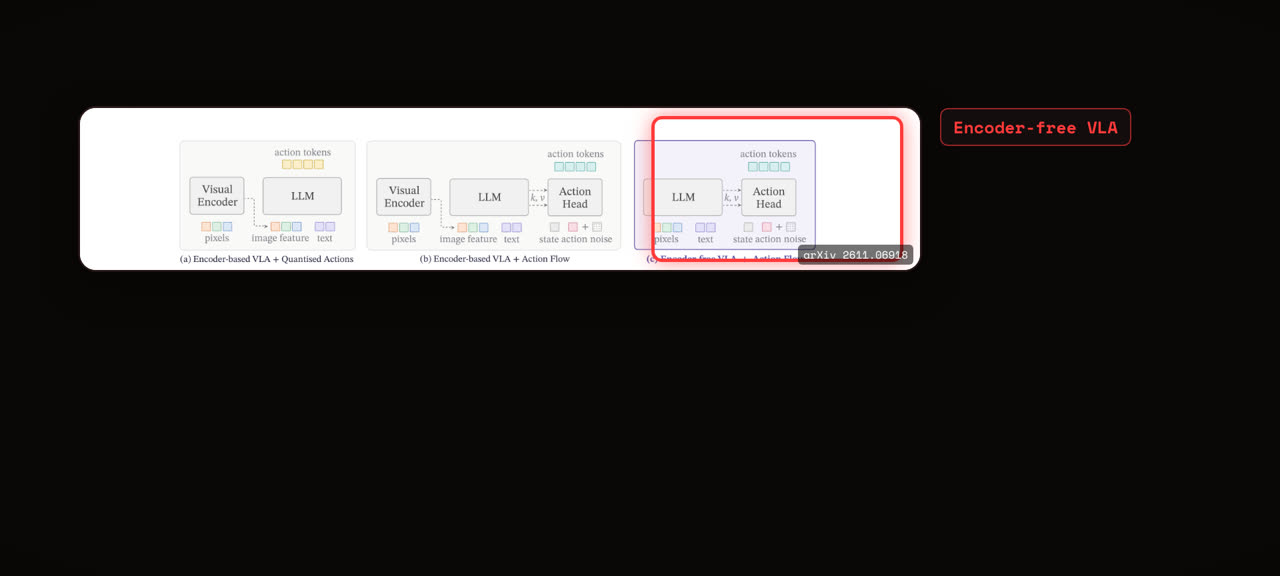
A new framework eliminates that visual compression step entirely. NEO-VLA feeds raw camera patches directly into the main transformer backbone alongside text instructions.
Joint Processing Pipeline
Under the hood, visual tokens and language instructions evolve jointly from step one. This allows the system to preserve fine-grained geometry and depth cues from the start.

Early Physical Control Cues
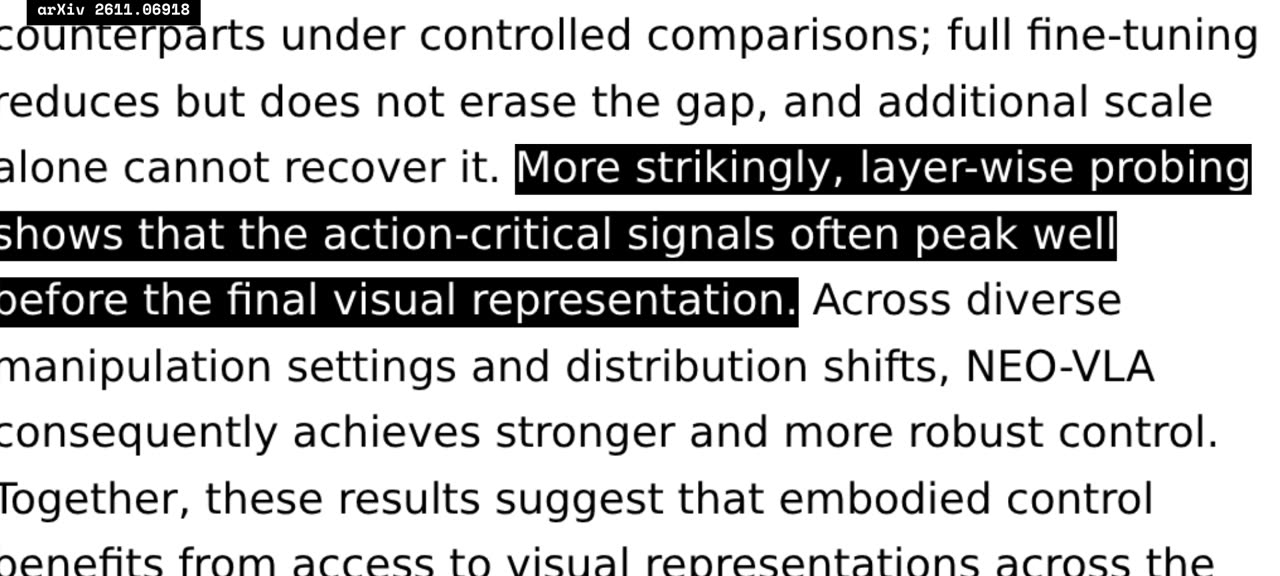
Researchers discovered that physical control cues actually peak early in processing. Checking early computation layers gives the robot much sharper geometry than final summaries.
Continuous Action Expert
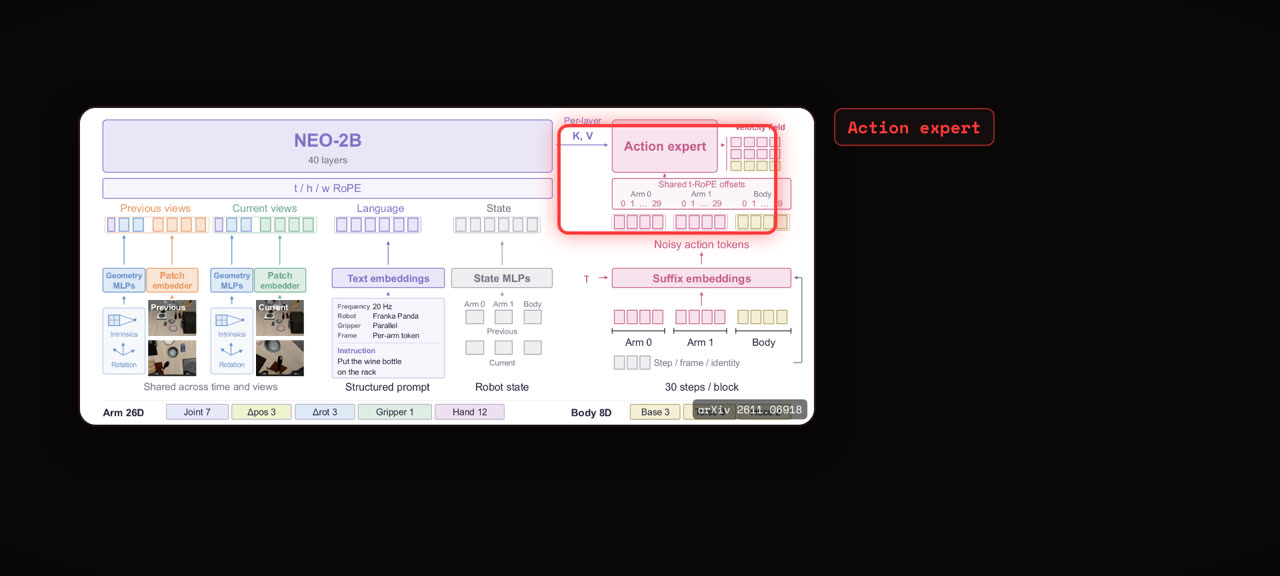
A continuous flow-matching expert reads cached features across multiple layers to steer the motors. It conditions on these caches and noisy actions to generate unified velocity fields.
Benchmark Performance Results
On the Libero manipulation benchmark, NEO-VLA achieved an average success rate of 90.9 percent with a frozen backbone. Across visual shifts and noisy camera angles, it achieved an overall score of 89.7.
Robustness in Randomized Environments
Under randomized RoboTwin environments, it preserved 69.40 percent accuracy from the clean split. This proves that native processing handles visual noise and perturbations better than encoder-based models.
Current Limitations
Despite strong results, the policy still struggles when facing completely unfamiliar spatial layouts and new goals. Performance also depends heavily on multimodal pretraining quality.
Watch the explainer
Watch on YouTube ShortsWatch on InstagramWatch on FacebookWatch on Threads
Music: "Investigations" Kevin MacLeod (incompetech.com), licensed under Creative Commons: By Attribution 4.0 — creativecommons.org/licenses/by/4.0/
How it works
- Combine multi-view images, structured prompt text, and robot proprioceptive states into a unified token stream.
- Process visual patches and language tokens jointly across the transformer backbone layers using native rotary position embeddings.
- Condition the flow-matching action expert on backbone layer caches and noisy actions to generate unified velocity fields for arms and body.
Key numbers
Why it matters
Robotics engineers and embodied AI researchers benefit from encoder-free architectures that retain crucial spatial information. By removing the bottleneck of compressed visual features, physical AI systems can achieve stronger cross-distribution generalization and more reliable manipulation in complex real-world environments.
Words to know
- NEO-VLA
- An encoder-free vision-language-action model for robots.
- LIBERO
- A benchmark suite for evaluating robotic manipulation policies.
- Flow-matching
- A generative modeling technique used here to predict continuous robot action trajectories.
Made with Maya — an AI-assisted explainer with an AI voice. Numbers come from the source; check the paper for the full details.
Comments
Post a Comment