Jeveration: Generating Visual Media in a Single Forward Pass

Jeveration is a new framework that generates images and dense predictions in a single forward pass instead of using slow iterative loops. It achieves high speeds while maintaining strong quality.
The paper, point by point
The Speed Problem in Visual AI
Traditional generative models rely on sequential steps. Autoregressive networks process tokens one by one, while diffusion models use slow iterative denoising.

Single-Pass Generation
Jeveration treats image generation as a set of parallel decisions made in a single forward pass by a frozen vision-language model.

Fixing Regional Incoherence
Parallel selection often causes distorted regions because independent parts fail to coordinate. Jeveration solves this by conditioning all code positions on a shared random state.
Unified Visual Architecture
Using shared adapters on a frozen model backbone, a single checkpoint supports text-to-image generation, image editing, and dense perception tasks.
Remarkable Speed and Quality
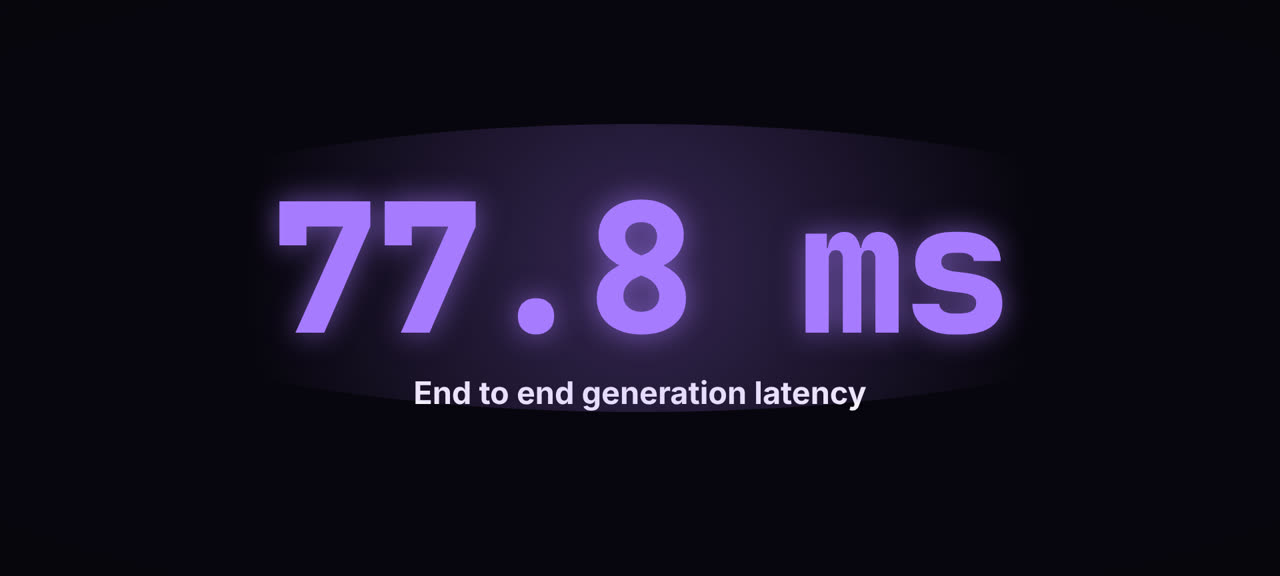
Experiments show that Jeveration generates a 512 by 512 pixel image in just 77.8 milliseconds on one H200 GPU, reaching a 0.74 GenEval score.
Current Limitations
Surface normal prediction lags slightly behind other tasks due to local geometry sensitivity across the shared task capacity.
Watch the explainer
Music: "Carefree" Kevin MacLeod (incompetech.com), licensed under Creative Commons: By Attribution 4.0 — creativecommons.org/licenses/by/4.0/
How it works
- Append decision tokens to the input, initializing them from a sampled random state or spatial queries.
- Process input and decision tokens through a frozen vision-language model using shared adapters in one forward pass.
- Map the final hidden states via task-specific heads into discrete image codes or dense predictions.
Key numbers
Why it matters
This approach points to an era of real-time generative applications running locally without expensive loops. Creators and developers can build faster tools that handle multiple visual tasks from a single checkpoint.
Words to know
- System One
- Fast, parallel decision-making without extended reasoning loops.
- GenEval
- A benchmark for evaluating compositional text-to-image models.
Made with Maya — an AI-assisted explainer with an AI voice. Numbers come from the source; check the paper for the full details.
Comments
Post a Comment