GTAGym: Evaluating and Training AI Agents on GTA V
Researchers created GTAGym, a benchmark and environment using GTA V missions to test and train AI models on complex physical and visual reasoning tasks.
The paper, point by point
Open world games challenge artificial intelligence
Open world video games require agents to spot targets, dodge traffic, and steer fast cars in milliseconds. Most existing benchmarks use toy grid puzzles instead of high dimensional visual environments.

GTAGym benchmarks AAA game tasks
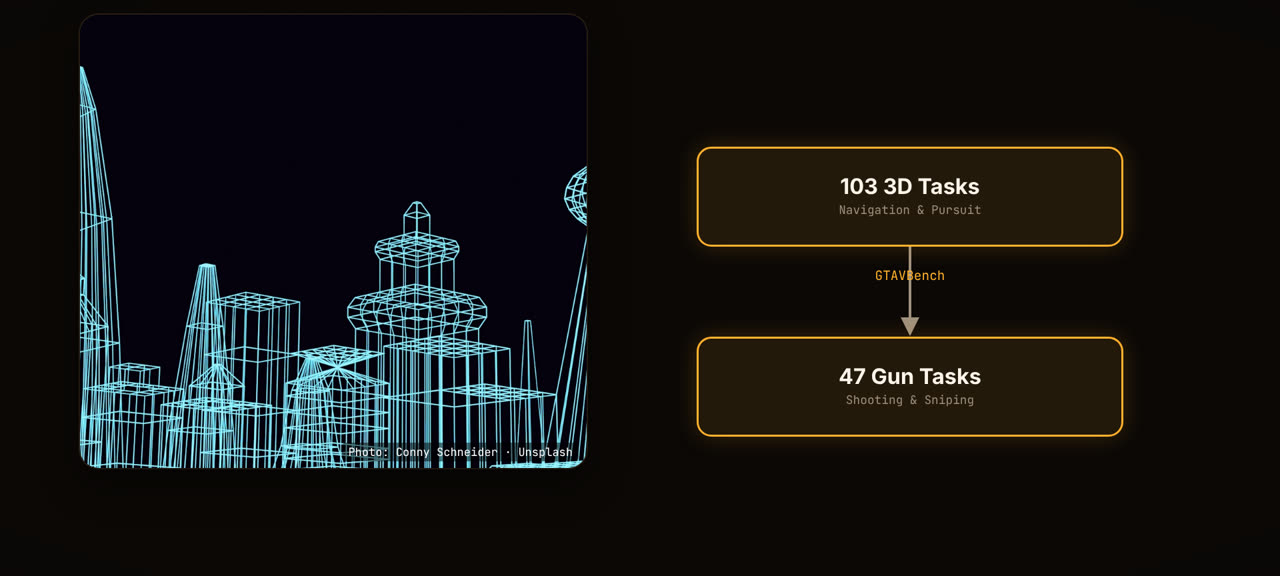
Researchers from Fudan University built GTAGym, an open benchmark featuring 103 full 3D tasks and 47 image-based shooting scenarios extracted from GTA V main-story missions.
Automated verification through game states
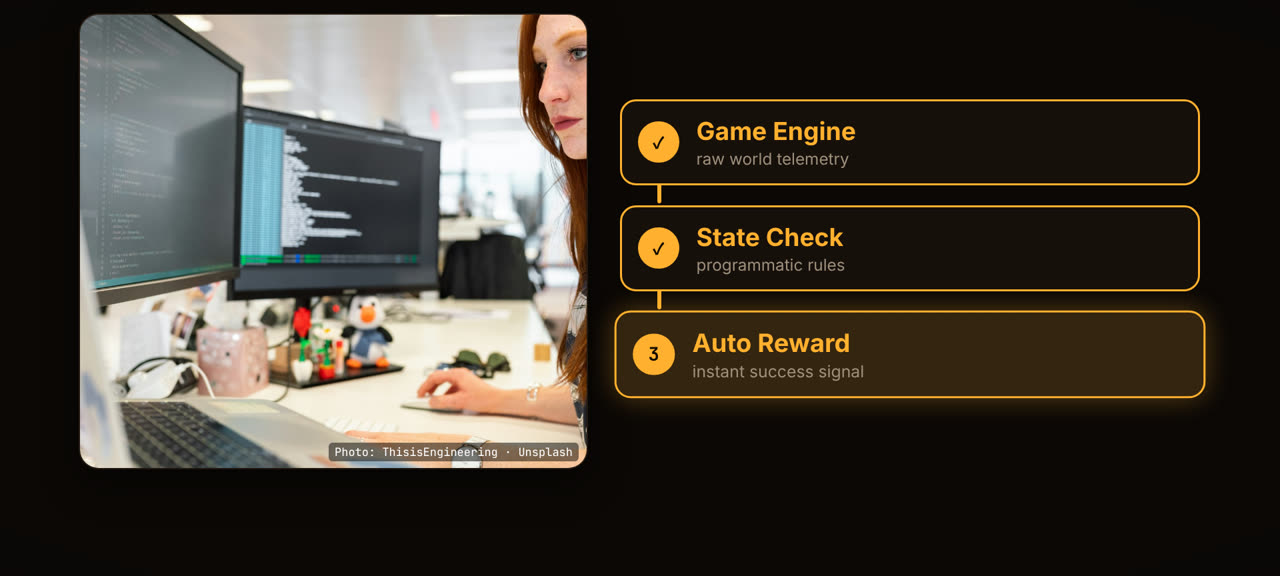
The environment reads engine states directly to verify mission completion. This automated approach eliminates human bias and checks success instantly.
Human players outperform top models
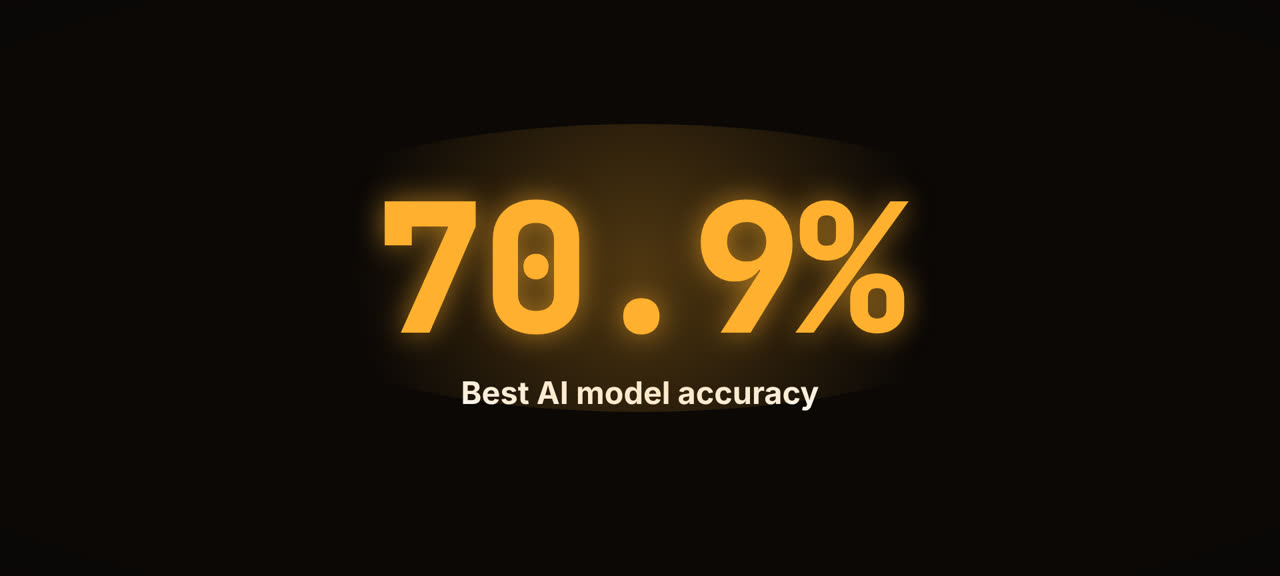
Human players complete nearly 90% of the open world challenges across the benchmark. Meanwhile, the best model setup only achieves 70.9% overall accuracy.
Dynamic maneuvers remain difficult
Specific dynamic actions like aerial chases and high speed evasion prove almost impossible for current models. Their spatial reasoning collapses when piloting planes or intercepting moving targets.
Reinforcement learning improves performance
Researchers fine-tuned Qwen 3.8-27B using lightweight LoRA reinforcement learning on procedural navigation courses. On held-out on-foot tasks, accuracy jumped from 54.2% to 72.9%.
Simulated training transfers to real games
Success on original GTA V game missions rose from 15% to 23% after training. This shows that simulated environments can successfully train general motor skills for unseen tasks.
Watch the explainer
Music: "Carefree" Kevin MacLeod (incompetech.com), licensed under Creative Commons: By Attribution 4.0 — creativecommons.org/licenses/by/4.0/
How it works
- Manually break down game missions into distinct subtasks with specific goals.
- Rebuild 3D scenarios and set up automated outcome checks using engine states.
- Run frontier vision-language models through screenshot and action interfaces.
- Train models using reinforcement learning on generated environments to improve task completion.
Key numbers
Why it matters
Video game environments serve as scalable, risk-free training grounds for physical artificial intelligence. By testing and training models in rich 3D virtual worlds, researchers can improve real-world robotic control and sim-to-real transfer without risking expensive hardware.
Words to know
- GTAVBench
- The evaluation benchmark containing tasks derived from GTA V main-story missions.
- LoRA
- A training technique that efficiently adapts large language models by updating only a small subset of weights.
- GRPO
- Group Relative Policy Optimization, an algorithm used for training models with reinforcement learning.
Made with Maya — an AI-assisted explainer with an AI voice. Numbers come from the source; check the paper for the full details.
Comments
Post a Comment