Google Gemini 4 Carbon Brings Advanced Reasoning and Security
Google built Gemini 4 Carbon for complex multi-step coding, deep research, and cybersecurity tasks. It delivers strong performance while keeping task costs low.
The paper, point by point
Built for complex reasoning tasks
Google built Gemini 4 Carbon for grueling multi-step coding, deep research, and cybersecurity.

Coordinating agent swarms
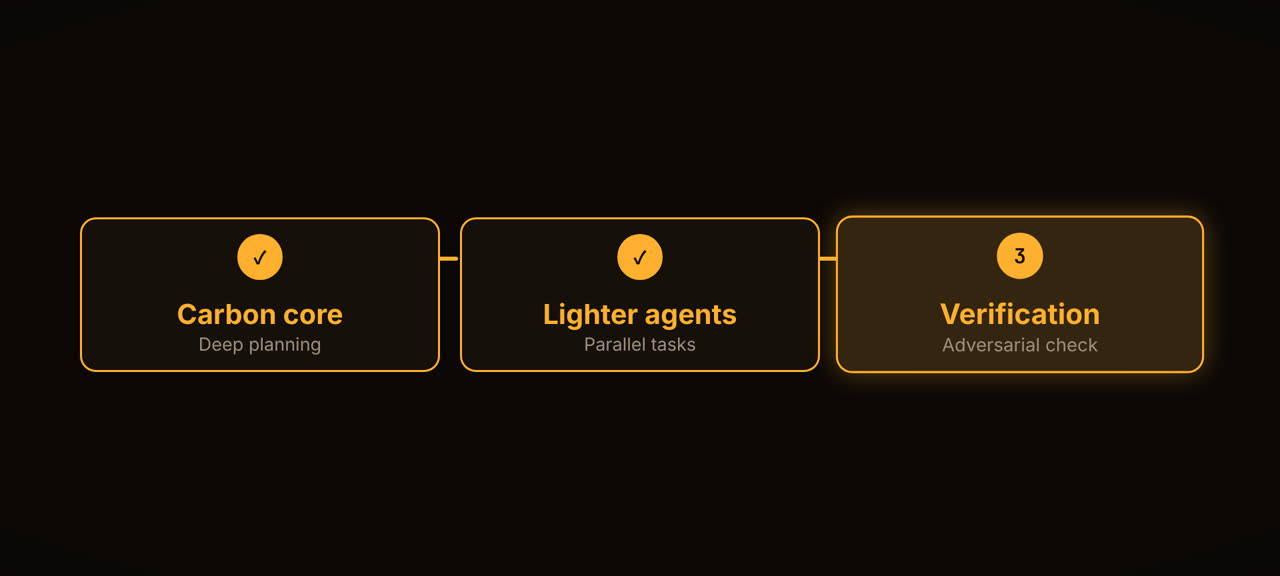
The model coordinates swarms of smaller helper agents that verify work in parallel.
Passing security tests
On the Gray Swan benchmark, its prompt injection success rate dropped to zero percent.

Resistances to cyberattacks
Against adaptive cyberattacks, breakthroughs plummeted from 3.1 percent down to 0.8 percent.

Competitive task costs
In benchmark testing, Carbon solved tasks at 7 dollars 76 cents each.
The token consumption catch
Deeper reasoning eats more tokens, so longer verification loops can still raise your bill.
Watch the explainer
Watch on YouTube ShortsWatch on InstagramWatch on FacebookWatch on Threads
Music: "Carefree" Kevin MacLeod (incompetech.com), licensed under Creative Commons: By Attribution 4.0 — creativecommons.org/licenses/by/4.0/
How it works
- Users submit a complex prompt or task into the system.
- Carbon takes on deep reasoning roles while lighter models run in parallel workspaces and verification loops.
- The coordinated team completes coding, research, or security auditing tasks.
Key numbers
Why it matters
Software teams and developers benefit from cheaper elite reasoning and autonomous cybersecurity auditing. These capabilities make complex debugging and vulnerability scanning faster and more accessible.
Words to know
- Gemini 4 Carbon
- Google's top-tier AI model built for deep reasoning and complex tasks.
- Fable 5.2
- Anthropic's top AI model that outperforms Carbon on certain tests.
Gemini 4 Carbon arrives just in time to feel like yesterday's news in the fastest model cycle yet
Made with Maya — an AI-assisted explainer with an AI voice. Numbers come from the source; check the paper for the full details.
Comments
Post a Comment