FastFrames: Real-Time Interactive Video Diffusion
Researchers at Apple and Cornell created FastFrames, an autoregressive framework that reduces video generation latency below fifty milliseconds by replacing slow image decoders and updating memory caches efficiently.
The paper, point by point
The Interactive Video Speed Problem
Most people believe video diffusion models are permanently stuck being far too slow for real-time interactive games. Generating thirty frames across one second is completely useless if the viewer must wait.

Introducing FastFrames
Researchers at Apple and Cornell created FastFrames to push diffusion directly into fluid interactive response speeds. It is an autoregressive generative framework designed specifically for zero-delay user feedback in world simulations.

Uncovering Hidden Bottlenecks
Most engineers assumed denoising math caused the drag during continuous generation. However, their detailed profiler revealed that hidden helper steps consumed over half the time.
Replacing the Heavy Pixel Decoder
The standard image decompression module alone was consuming as much compute as three entire transformer passes. They replaced that heavy decoder with a lightweight convolutional head and linear projection.

Fixing Memory Updates
Instead of executing another full transformer forward pass to update memory, a tiny neural network predicts cache corrections instantly. This maintains long-term visual coherence across frames without extra compute waste.
Drastic Speed Improvements
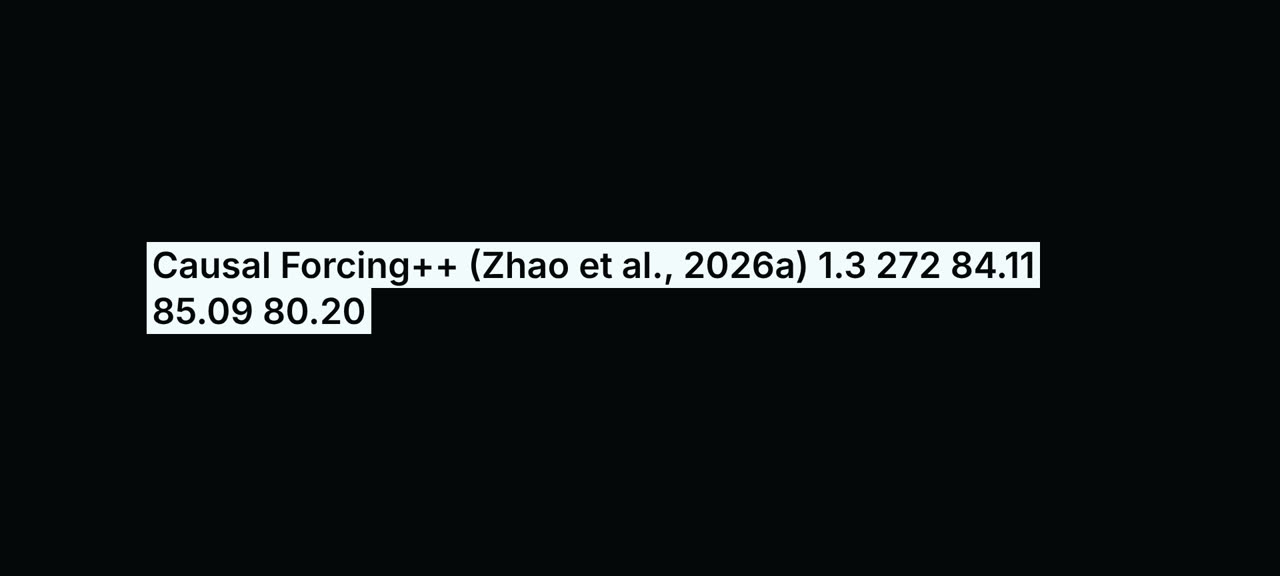
Previous leading methods like Causal Forcing required two hundred and seventy-two milliseconds for one single frame. FastFrames drops that per-frame response down to thirty-six milliseconds on one Nvidia B200 chip.
Scaling Up Model Capacity
Even when scaling up tenfold in model capacity, responsive real-time generation remained completely rock solid. The fourteen-billion-parameter network completes full frames in forty-five milliseconds across an eight-chip compute node.
Enabling Instant World Simulations
Neural simulators can now react instantly to steering wheels, camera pans, and keyboard actions. Autonomous robots can also query dynamic world models as fast as real-world physics unfolds.
Watch the explainer
Music: "Airport Lounge" Kevin MacLeod (incompetech.com), licensed under Creative Commons: By Attribution 4.0 — creativecommons.org/licenses/by/4.0/
How it works
- A lightweight network predicts residual corrections for noisy keys and values without running a full diffusion transformer pass.
- Performs fast two-step diffusion sampling using optimized tensor cores and attention backends.
- A causal ConvNeXt pixel decoder and linear layer rapidly unpatchify and upsample latents directly into RGB frames.
Key numbers
Why it matters
Game developers and robotics engineers benefit from generative models that react instantly to user inputs or environmental changes. This breakthrough bridges the gap between high-quality AI video generation and real-time interactive applications.
Words to know
- VAE
- Variational Autoencoder, a neural network used to compress images and videos into compact latent representations and decode them back.
- DiT
- Diffusion Transformer, a neural network architecture combining diffusion models and transformers for generation.
- KV cache
- Key-Value cache, a memory buffer storing previously computed transformer states to avoid recomputing past frames.
Made with Maya — an AI-assisted explainer with an AI voice. Numbers come from the source; check the paper for the full details.
Comments
Post a Comment